Pages

Wednesday, March 8, 2023

Aveiro & Coimbra

Wednesday, 8 March 2023


We had breakfast in the little coffee shop that Amy had been frequenting from morning one.


Today, we have scheduled a ‘small group tour’ Aveiro & Coimbra with a River Cruise.  Meeting in front of City Hall.


We turned out to be the only members in the group.  It is going to be a rainy day - perfect for being stuck in a van.


So, we travel for an hour and a half to the waterfront city of Coimbra, the capital of Portugal during the First Dynasty, from 1131 to 1255.


Our first stop was the botanical garden, a peaceful oasis - especially in the rain, with over 1200 species of plants from around the world.  


Literally overshadowing (if there were sunshine) near the gardens is a Roman Aqueduct.


The Roman Aqueduct was built during the reign of Emperor Augustus in the 1st century AD. The 2-mile structure was constructed to transport water to the Roman city of Aeminium, which is now modern-day Coimbra.


Moving to the University, we enter the main courtyard through The Iron Gate, a historic gate built in the 1630s and is decorated with the coat of arms of the University of Coimbra.


Dominating the courtyard is the royal palace now known as The Palace of the Schools is a magnificent building dating back to the 16th century, and converted into a university building in the 18th century.


Connected to the palace on another side of the courtyard is The Chapel of Saint Michael, known for its elaborate Baroque decoration.


In the center of the plaza, there is a statue of King Joao III, who founded the university in 1537.


Next to the Chapel is the Joanina Library, a Baroque masterpiece, recognized as one of the most beautiful libraries in the world, with stunning frescoes, gilded woodwork, and thousands of ancient books.


Tours of the Library are timed entrances every 20 minutes.  The que is admitted first into the Academic Prison is a small room located in the library basement that was used to punish students who broke the university's rules.


The group is then admitted for 10 minutes to the lower library.  Many old books, but not much to look at.


Finally, the group is admitted to the main Library.  WOW.  Photos are not permitted, but as you know, not everyone follows the rules, so this is an image from others of this amazing space.


The Library is home to several species of bats, including the Common Pipistrelle and the Greater Horseshoe Bat. The bats are believed to have been living in the library since it was first built, and they play an important role in preserving the books. Bats eat insects, including bookworms and moths, which can damage the books. The bats in the Joanina Library help to protect the collection by keeping the insect population under control.

DALL-E AI: “a bat reading a book painting like Paula Rego”

After the university/library we headed to the historic city center for a brief shopping stroll.  One of the interesting things we found were Suspiros, a big beige cracked sweet made with sugar and whisked egg whites.


Next, there is a 45 minute drive to Aveiro for lunch, some site seeing, and we a Moliceiro boat ride.  Moliceiro boats are characterized by their colorful and ornate decorations, which typically feature images of historical events, popular legends, or everyday life in the region of Aveiro. The boats are relatively long and narrow, with a flat bottom and a pointed bow and stern. They are propelled by a long oar, known as a "haste," which is operated by a skilled oarsman.


We had a traditional Portuguese meal: Arroz de Marisco: ‘seafood rice.’  at O Legado da Ria. 


Followed by a little walk around town before heading back to see if a boat ride is still on the schedule.  It is not.  The wind and rain will make a tour of the canals a bit cold.  There is a backup plan:  A Tuk-Tuk tour… 


A Tuk Tuk tour is a type of sightseeing tour that uses a small, three-wheeled vehicle called a tuk tuk.  It was moderately better than a boatride in the rain.  There were plastic sides, but they needed to be zipped and unzipped to travel or to see the city.


An interesting industry in Aceiro is sea salt.  The fields are flooded with seawater and the sun evaporates the water, leaving the salt to be harvested.


We also got to sample Ovos moles de Aveiro, a traditional sweet of Aveiro. It is a type of candy made from a mixture of egg yolks and sugar, which are cooked over low heat until they become thick and creamy.


The mixture is then molded into various shapes, including shells, fish, and barrels, using wooden molds, which are unique to the region. The final product is then coated with a thin layer of rice paper, giving it a slightly crunchy texture.  We did not think they were that exciting.


Moving on, we headed to the Costa Nova do Prado, a historic fishing village just a few kilometers from Aveiro, famous for its colorful striped houses.


The houses were originally built in the 19th century as fishermen's cottages. The stripes on the houses allowed the fishermen to navigate to their homes.  Today, these homes are summer homes.  This was the last of the stops before heading back to Porto.


Our guide dropped us at the Livraria Lello Bookstore, one of the most beautiful bookstores in the world.  It has been featured in several films, including Harry Potter and the Sorcerer's Stone.  The bookstore was designed by architect Francisco Xavier Esteves and features a stunning neo-Gothic facade, stained glass windows, and a grand staircase.  Due to its popularity, the bookstore charges 5€ admission (refundable with purchase).  And yes, there is a line in the plaza out front.


After buying Barney a Portugese Cookbook, he proved he still has trouble reading the walking maps.  Construction and road closures did not help, but we finally made it to Tapabento.  Another restaurant that specializes in traditional Portuguese cuisine with a contemporary twist and is known for its delicious tapas.


Then another Uber ride home.


Tuesday, March 7, 2023

Taberna Real do Fado

 Tuesday, 7 March 2023 - Continued.

Taberna Real do Fado

Fado is a traditional style of music that originated in Portugal, it is believed to have developed in the early 19th century, drawing on a mix of musical and cultural influences from Portugal, Africa, and Brazil.


Fado is typically performed by a solo singer, accompanied by a classical guitar and a Portuguese guitar, which is a stringed instrument with a distinctive teardrop shape. The lyrics of fado songs often deal with themes of longing, love, loss, and the struggles of everyday life.

For a discussion of the meal, visit my companion blog, Dining With Barney 

We arrived at the venue a half hour before our 8pm reservation - the Uber driver was worried as it was locked up tight. Undeterred, we went for a walk to take some pictures of the full moon.

We found this venue online before we left NJ.  Once in Porto, we saw many venues offering fado shows.  With so many previous bad ‘dinner theater’ experiences, Amy and I started to have fears over the potential quality of the show.  The fears were unfounded.  The venue takes its fado (and food) very seriously.  There was an announcement that fado is performed in silence (with the full attention of the audience) - an encouraging sign.


The restaurant seats about 80 guests - there were about 30 in the audience tonight.


The first two performances were two numbers by the musicians, two by the female singer, and two by the male singer - who was also the maître d' and waiter.


Here are a few photos of some of the food... Cod Fritters.


Octopus


Crème brûlée


During dinner, we spoke with a fellow diner, who seemed to be a regular and know all the staff.  He explained he was a heart surgeon (he had done 4 open heart surgeries that day) and loved fado to help him relax at the end of the day.


First Full Day in Porto

 Tuesday, 7 March 2023

Amy was up early and found a nice coffee shop.


Once Barney was up, we had breakfast at the hotel and did a little exploration of the hotel, like the outdoor gym.


When the time came, we crossed the street to the Heroismo station to take the bus downtown.  We asked at the hotel and were told the bus would be 1€ each.  It was 2.50€.


We got off the bus, near the National Theatre.  Walking around Porto is a delightful experience, full of history, culture, and beautiful sights. The city is known for its charming old town, home to stunning architecture and winding streets,


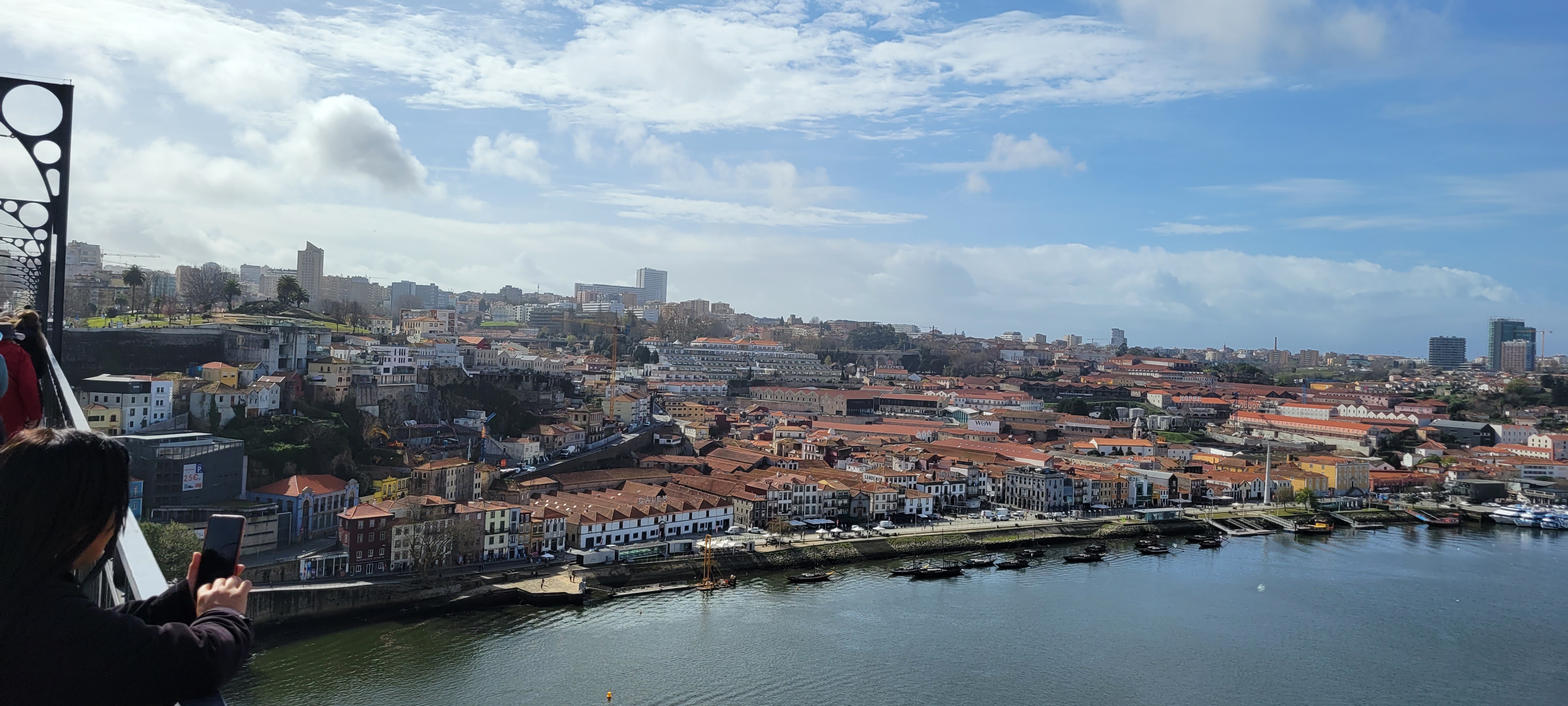
We took a stroll onto the top level of the Dom Luís I Bridge - we saw this bridge from the river level last night.


The Sé do Porto (Cathedral of Porto), was built between the 12th and 13th centuries.


Construction of the cathedral began in the 12th century, during the reign of Portugal's first king, Afonso Henriques, and was completed in the 13th century. 


The cathedral has undergone numerous renovations and additions over the centuries, resulting in a mix of architectural styles that includes Romanesque, Gothic, Baroque, and Rococo elements.


After the Cathedral, we explored several small hilly streets on our way to lunch at the century-old Cervejaria Gazela.  We had the special hot dog, some of the best french fries we can remember and a steak and cheese sandwich that was served on a small version of what is sold in NJ as ‘Portuguese rolls’ - I love it when names line up with reality!  


We continued our walking tour toward the Mercado do Bolhão. 


Known for selling a wide variety of fresh fruits, vegetables, meat, fish, and flowers.


The market has been in operation since 1914, housed in a two-story neoclassical building with a distinctive facade. Ex
tensive renovations started in 2018.


We walked to the São Bento Train Station The lobby has over 20,000 hand-painted
azulejo tiles, dating from 1905–1916. 


At the train station, we inquired about buying tickets for Friday’s train trip from Porto to Vigo, Spain, and beyond.  We learned there was a TRAIN WORKERS’ STRIKE scheduled for Friday, and we would have to make other arrangements.

With the newfound hick-up to our plans, we took the Metro (subway) back to the Heroismo Station and the hotel to get ready for the Dinner Show this evening.

Tonight’s Dinner Show is at Taberna Real do Fado.

Monday, March 6, 2023

1st Post-COVID International Trip: Portugal

 Monday, 6 March 2023

We left Newark Liberty Airport 


at 12:15 am on TAP Air Portugal for the nearly 7-hour flight to Porto, Portugal.  Checking in was an experience.  They were carefully weighing all the luggage AND the carry-ons!  Many people were rearranging their belongings to make the scales balance - we passed the first time.


The airplane food was unremarkable, the choice of a chicken dish or cheese tortellini, but the wine was free!  Looking back that the trip’s food experiences, the airline food was a huge disappointment.

When we arrived in Porto and cleared immigration and customs, the car, arranged for us by the hotel,  was ready and waiting.

We were able to promptly check right into the Eurostar Heroismo Hotel. 


After getting settled, we took a walk to find lunch at Dona Mira (meals will be described on my “Dining with Barney” blog) a lovely little cafe with toasts and sandwiches.

Returning to the hotel we rested until it was time to walk to dinner.  We learned firsthand that Porto is situated on hills at the top of cliffs leading to the Duoro River.  The weather had also turned drizzly - a condition that would remain most of our time in Porto.

Along the route, we stopped at the Miradouro das Fontainhas. 


Miradouro means “viewpoint” - we will have lots of these this week.  This lead us to a long set of stairs to the river.  Along the walk, we also saw the Funicular dos Guindais.

The Dom Luís I Bridge is a double-deck metal arch bridge, with a total length of 385 meters (1,263 feet) and a height of 85 meters (279 feet) above the Douro River. The upper deck is used by pedestrians and the metro system, while the lower deck is used by pedestrians.  


It was designed by Belgian engineer Théophile Seyrig, who was a student and colleague of Gustave Eiffel. Construction began in 1881 and was completed in 1886. 

Dinner reservations were at Restaurante o Terreirinho.  This was our first encounter with specific, but unclear google walking instructions. 


The intent was to walk along the busy restaurant-lined Ribeira do Porto; turn into an alley; turn into another alley; turn up a flight of stairs and arrive.  We did walk in a small spiral but were directed to an alternate alley for the approach. 


Here we had a wonderful dinner.  Again complete meal details are on the other blog.

The Funicular closed at 8 pm so we had to find another way back to the hotel:  a 4€ trip on Uber!