![]() |
Founded 711 CE |
Showing posts with label Shrine. Show all posts
Saturday, October 12, 2019
Saturday, October 5, 2019
Catching Up With the Temple We Missed This Morning
Fortified with lunch, the three of us head back out to the skipped Ryoanji Temple to see the Zen Rock Garden or "Dry Landscape Garden" and rest of the complex.
![]() |
| There was a 30-minute wait for personal Goshuin, so I opted for a pre-written slip of paper to place in my book |
Near the teahouse is a famous stone water basin, with water continually flowing for ritual purification. This is the Ryōan-ji tsukubai, which translates as "crouch"; because of the low height of the basin, the user must bend over to use it, in a sign of reverence and humility. The kanji written on the surface of the stone basin, 五, 隹, 止, 矢, are without significance when read alone. Though the water basin's frame is circular, the opening in the circular face is itself a square (口). If each of the four kanji is read in combination with 口 (the square-shaped radical is pronounced kuchi, meaning "mouth" or "aperture"), which the square opening is meant to represent, then the characters become 吾, 唯, 足, 知. This is read as "ware, tada taru (wo) shiru", which translates literally as "I only sufficiency know" (吾 = ware = I, 唯 = tada = merely, only, 足 = taru = be sufficient, suffice, be enough, be worth, deserve, 知 = shiru = know)[16] or, more poetically, as "I know only satisfaction". Intended to reinforce Buddhist teachings regarding humility and the abundance within one's soul, the meaning is simple and clear: "one already has all one needs". (Wikipedia)The top left red stamp on the Goshuin is a representation of this kanji written on the surface of the basin.
Now we took the bus to see if Nijojo has any smaller lines... alas, No.
So back to the hotel to get ready for the theatre.
Location:
Kyoto, Japan
Friday, October 4, 2019
Off to See the World
Kyoto, Japan
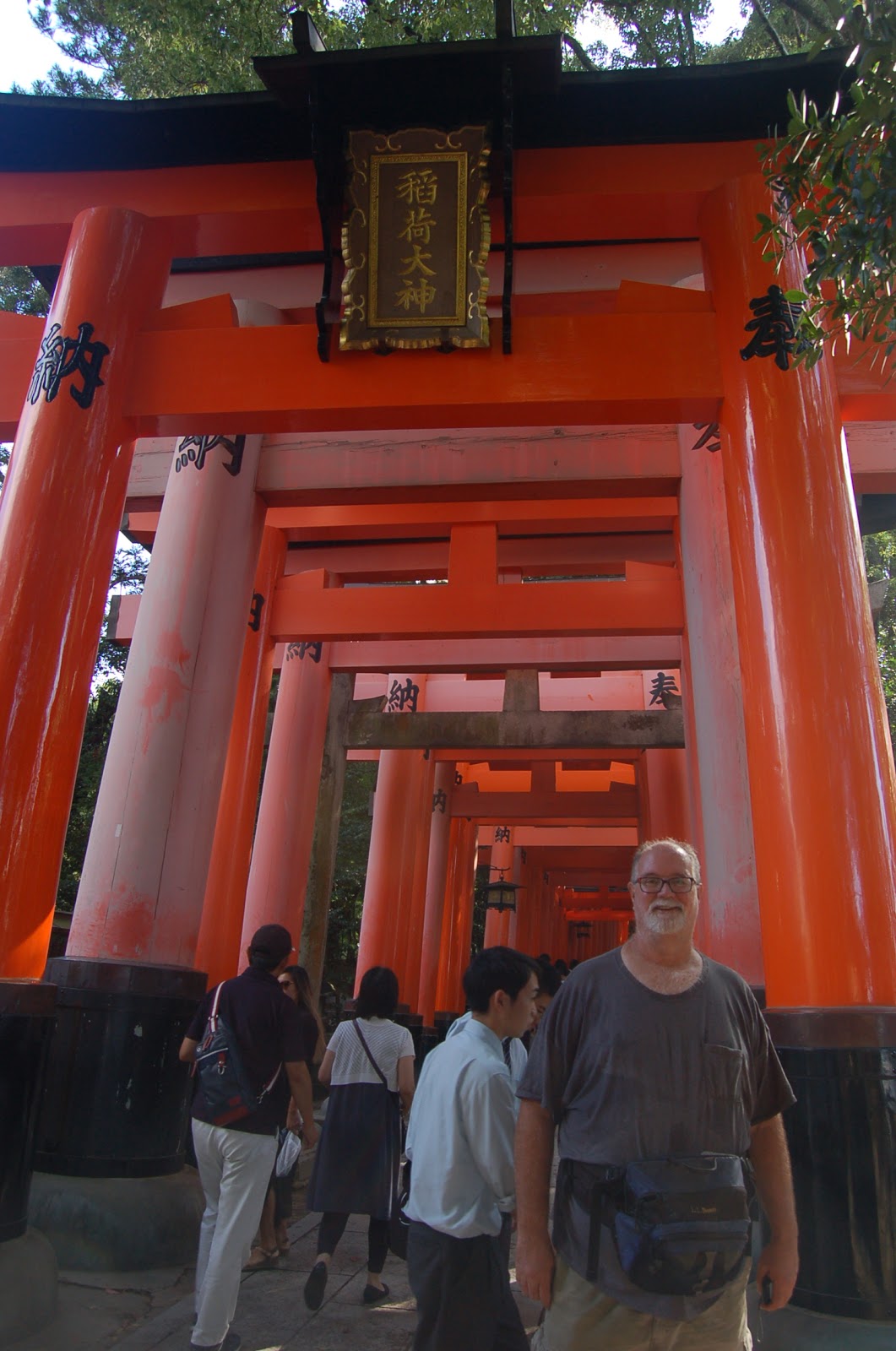
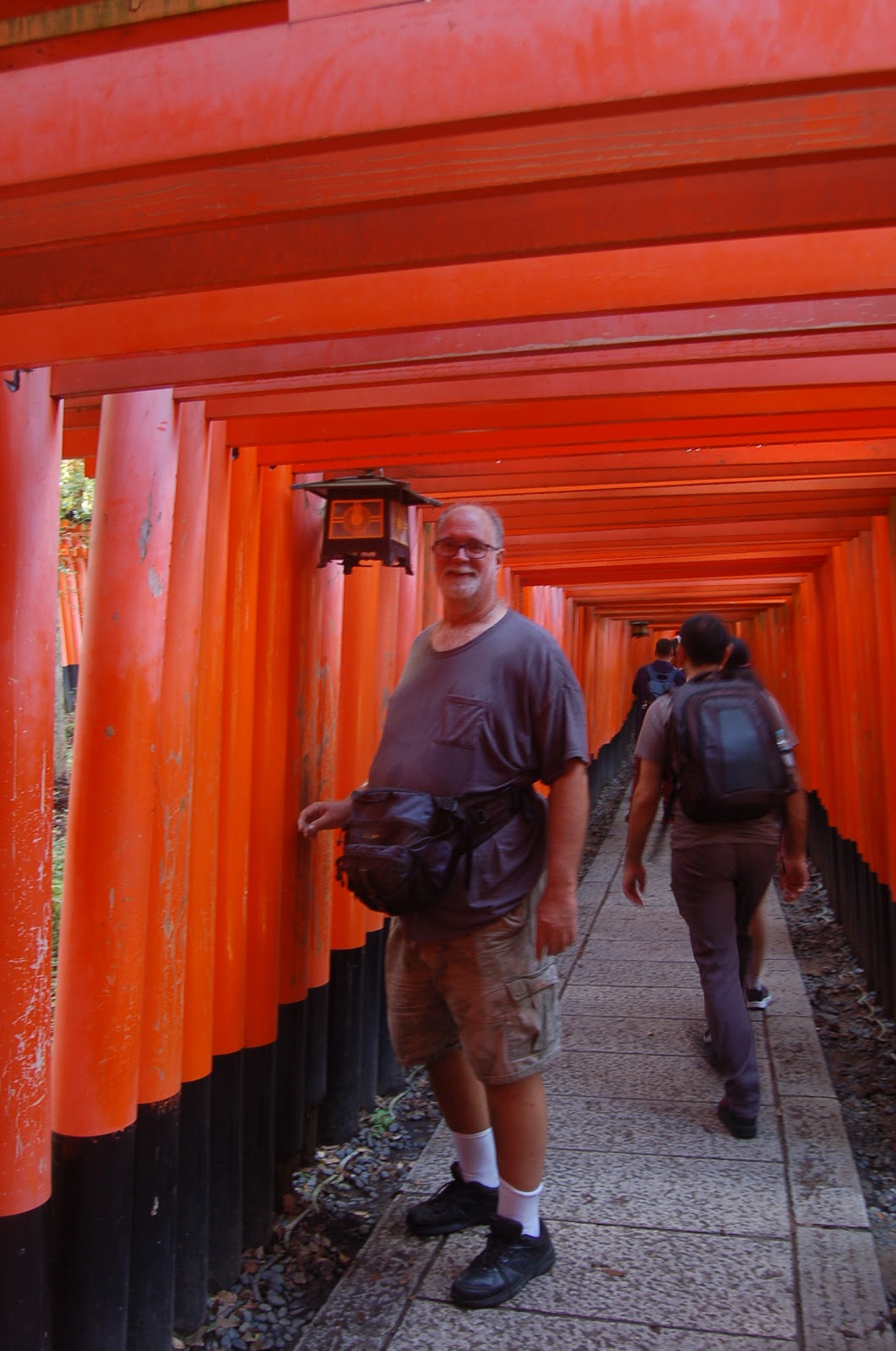
After breakfast, we walked to the train to Fushimi Inari Shrine and Fukakusa Yabunouchicho
This is a Goshuin. Most Temples and Shrines, issue a Goshuin, this red stamp document. They are collected in a Goshuincho, translated as "Honorable Stamp/Seal Book." The basics are that they historically proof of attendance at a temple or shrine. The calligraphy is the date, the name of the shrine or temple, the words "奉拝 (houhai)" (which means to worship), and a stamp with the name of the shrine. The full story and an explanation of the seal's origins and collections can be found here. I collected several in my Honorable Book. Our friend Yuko added the post-a-notes so I would remember where they came from. The stamps were 300 yen each, and most are done while you wait and watch. Some sites had one calligrapher; the most I saw was six at one Temple.
An excellent reference for the manners expected at a shrine can be found here.
| Young men on a school trip, performing the ritual cleansing before entering the temple |
Fushimi Inari is the most important of several thousands of shrines dedicated to Inari, the Shinto god of rice. Foxes are thought to be Inari's messengers, resulting in many fox statues across the shrine grounds. Fushimi Inari Shrine has ancient origins, predating the capital's move to Kyoto in 794.
| The foxes have various things in their mouths. |
Flanking the entrance to temples. there are two figures associated with the temple. One will always have the mouth open and one the mouth closed.
This complex is known for its foxes
Then we took the train to the hotel and changed to walk to the
13 Okazaki Saishojicho, Sakyo Ward, Kyoto, 606-8342, Japan
Then across the street to the
The writer/director of the theatre piece has done a film included in the exhibition "Dress Code"

Then Off to a local Udon Noodle Shop
Location:
Kyoto, Japan
Thursday, October 3, 2019
Arrival in Kyoto, Japan
Kyoto, Japan
Our first dinner in Japan was at
Magurofactory, 220, 1-chōme Miyagawasuji, Higashiyama Ward, Kyoto, 605-0801, Japan
| Exterior |
A practice, never fully explained, is to pour the sake to overflowing into a bowl below the glass. Highballs were offered everywhere.
![]() |
| Over-flowing Sake, edamame, Highball, and pickled veggies. |
Not all tuna nigiri is raw.
![]() |
| Map of the parts of a tuna. We would see this MANY times on the trip, this is just a cute tabletop version. |
This was a very interesting, the oven hot dish and the rice cooked the egg, making a bowl of rich creamy rice with the warm tuna on top.
![]() |
| White truffle scented tuna ball cocot |
On the way back, we stopped at our first shrine: Tatsumidaimyojin, 59 Motoyoshicho, Higashiyama Ward, Kyoto, 605-0087, Japan
This shrine is on a point between a fork in the road.
Nicely surrounded by trees this neighborhood shrine, The Tatsumi Daimyojin Shrine is a tiny local shrine frequented by neighborhood geisha. We did see several geisha during our walk.
Then back to the hotel b sanjo
Subscribe to:
Posts (Atom)