Pages

Showing posts with label Temple. Show all posts

Monday, October 7, 2019

A Little Further Out From Tokyo


From Yokohama we take an hour train ride to Kamakura Station, where we move to another smaller train to Hase, where the Great Buddha resides.


The bronze statue probably dates from 1252, in the Kamakura period, according to temple records. It was preceded by a giant wooden Buddha, which was completed in 1243 after ten years of continuous labor, the funds having been raised by Lady Inada (Inada-no-Tsubone) and the Buddhist priest Jōkō of Tōtōmi. That wooden statue was damaged by a storm in 1248, and the hall containing it was destroyed. (Wikipedia)


We took the bus BACK to Kamakura Station, where we were joined by Yuko.  We explored the town and went to dinner.


Saturday, October 5, 2019

Catching Up With the Temple We Missed This Morning

Fortified with lunch, the three of us head back out to the skipped Ryoanji Temple to see the Zen Rock Garden or "Dry Landscape Garden" and rest of the complex.


There was a 30-minute wait for personal Goshuin,
so I opted for a pre-written slip of paper to place in my book
Ryoan-ji was built on the grounds of a villa of the Fujiwara clan in the Heian period (794-1185). The deputy of the shogun and warlord Hosokawa Katsumoto bought the estate in 1450 and built his residence on it, together with the temple Ryōan-ji.


The Rock Garden. Along with its origins, the meaning of the garden is unclear.
Some believe that the garden represents the common theme of a tiger carrying cubs
across a pond or of islands in a sea, while others claim that the garden represents
an abstract concept like infinity.
 Near the teahouse is a famous stone water basin, with water continually flowing for ritual purification. This is the Ryōan-ji tsukubai, which translates as "crouch"; because of the low height of the basin, the user must bend over to use it, in a sign of reverence and humility. The kanji written on the surface of the stone basin, 五, 隹, 止, 矢, are without significance when read alone. Though the water basin's frame is circular, the opening in the circular face is itself a square (口). If each of the four kanji is read in combination with 口 (the square-shaped radical is pronounced kuchi, meaning "mouth" or "aperture"), which the square opening is meant to represent, then the characters become 吾, 唯, 足, 知. This is read as "ware, tada taru (wo) shiru", which translates literally as "I only sufficiency know" (吾 = ware = I, 唯 = tada = merely, only, 足 = taru = be sufficient, suffice, be enough, be worth, deserve, 知 = shiru = know)[16] or, more poetically, as "I know only satisfaction". Intended to reinforce Buddhist teachings regarding humility and the abundance within one's soul, the meaning is simple and clear: "one already has all one needs". (Wikipedia)
The top left red stamp on the Goshuin is a representation of this kanji written on the surface of the basin. 


Now we took the bus to see if Nijojo has any smaller lines... alas, No.

So back to the hotel to get ready for the theatre.

Friday, October 4, 2019

The Higashiyama Ward Temple and Pagoda

Kyoto, Japan

We took a cab to the next site.  Through the narrow streets to the top of the hill.

Yasaka-no-to, most pagodas are associated with temples and other buildings. This was the Hokanji Temple. The associated buildings, in this case, have all been destroyed by fire, war, and earthquakes.

One of the most scenic views in Kyoto.

The Hokanji Temple (法観寺) was built in 592, which is the oldest pagoda in Kyoto.


In this area, there is the small Kongoji Temple.  The temple was founded in Enryaku 8 years (789)


Thanks to Amy for the images of the Kongoji Temple


Off to See the World

Kyoto, Japan

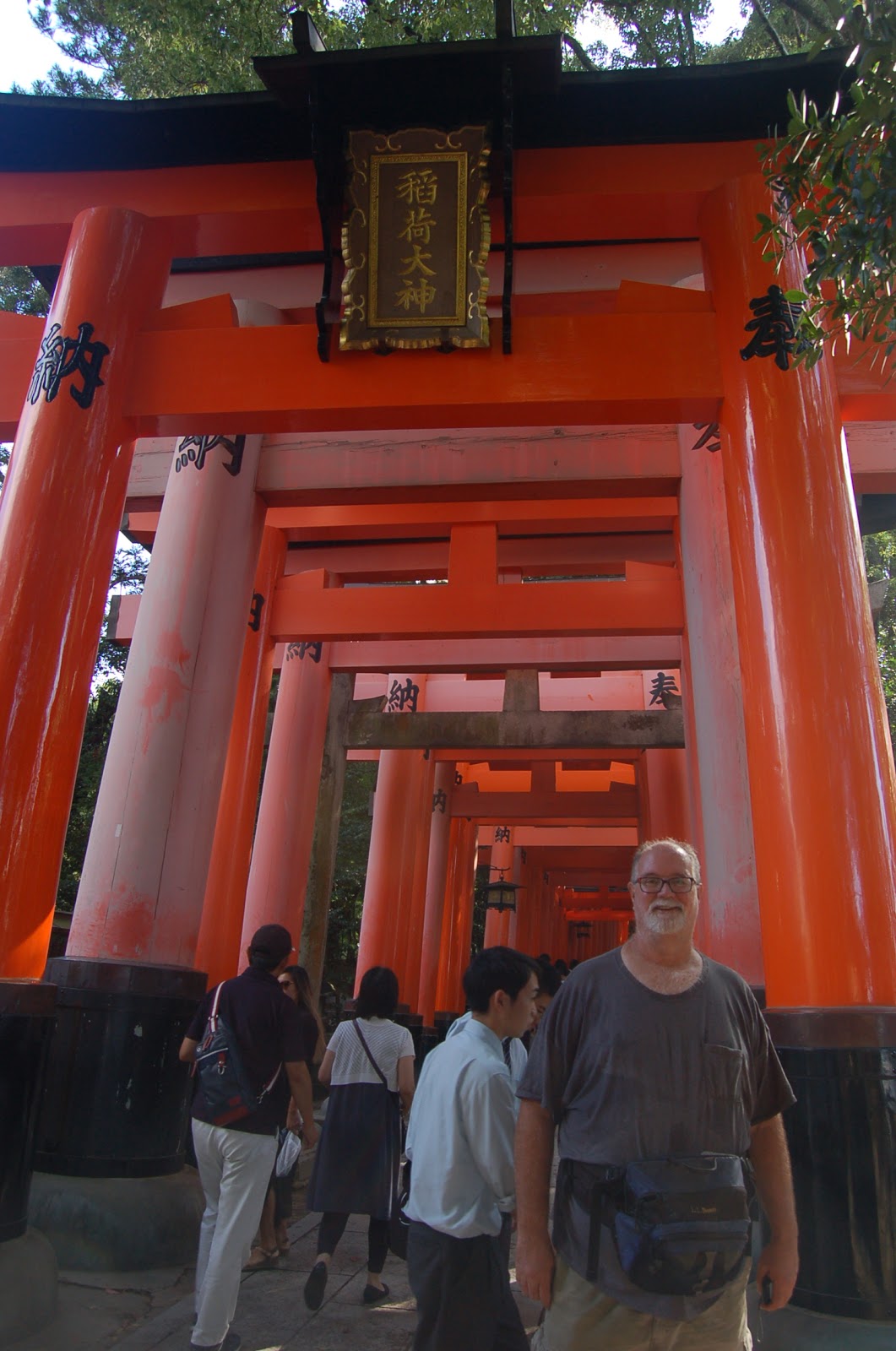
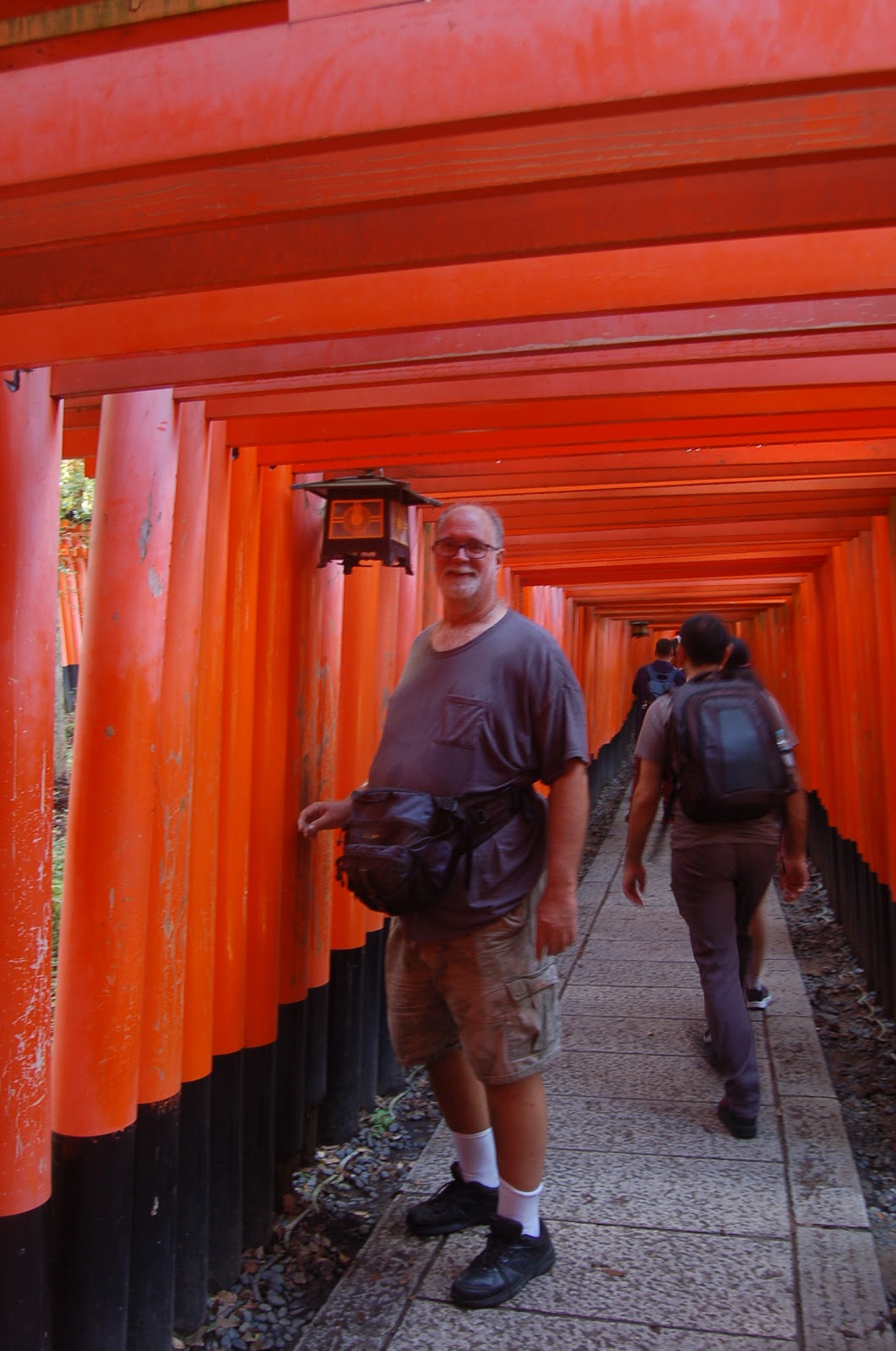
After breakfast, we walked to the train to Fushimi Inari Shrine and Fukakusa Yabunouchicho


This is a Goshuin.  Most Temples and Shrines, issue a Goshuin, this red stamp document.  They are collected in a Goshuincho, translated as "Honorable Stamp/Seal Book." The basics are that they historically proof of attendance at a temple or shrine.  The calligraphy is the date, the name of the shrine or temple, the words "奉拝 (houhai)" (which means to worship), and a stamp with the name of the shrine.  The full story and an explanation of the seal's origins and collections can be found here.  I collected several in my Honorable Book.  Our friend Yuko added the post-a-notes so I would remember where they came from.  The stamps were 300 yen each, and most are done while you wait and watch.  Some sites had one calligrapher; the most I saw was six at one Temple.


An excellent reference for the manners expected at a shrine can be found here.


Young men on a school trip, performing the ritual cleansing before entering the temple
Fushimi Inari is the most important of several thousands of shrines dedicated to Inari, the Shinto god of rice. Foxes are thought to be Inari's messengers, resulting in many fox statues across the shrine grounds. Fushimi Inari Shrine has ancient origins, predating the capital's move to Kyoto in 794.


The foxes have various things in their mouths.


Flanking the entrance to temples. there are two figures associated with the temple.  One will always have the mouth open and one the mouth closed.


This complex is known for its foxes


Then we took the train to the hotel and changed to walk to the 
13 Okazaki Saishojicho, Sakyo Ward, Kyoto, 606-8342, Japan


Then across the street to the 
The writer/director of the theatre piece has done a film included in the exhibition "Dress Code"


Then Off to a local Udon Noodle Shop