Pages

Saturday, October 5, 2019

Kyoto Experiment: Kyoto International Performing Arts Festival

chelfitsch & Teppei Kaneuji
Eraser Mountain

Playwright/Director: Toshiki Okada
Scenography: Teppei Kaneuji
Cast: Izumi Aoyagi, Mari Ando, Yuri Itabashi, Takuya Harada, Makoto Yazawa, Yo Yoshida, Leon Kou Yonekawa


This Poster for Eraser Mountain seems to have nothing to do with the show...

Toshiki Okada is a Japanese playwright, theater director, novelist, and founder of the theatrical company chelfitsch. He is known for "his use of hyper-colloquial Japanese and his unique choreography."


The Set
Outdoor Festival
Outdoor DJ Booth


Catching Up With the Temple We Missed This Morning

Fortified with lunch, the three of us head back out to the skipped Ryoanji Temple to see the Zen Rock Garden or "Dry Landscape Garden" and rest of the complex.


There was a 30-minute wait for personal Goshuin,
so I opted for a pre-written slip of paper to place in my book
Ryoan-ji was built on the grounds of a villa of the Fujiwara clan in the Heian period (794-1185). The deputy of the shogun and warlord Hosokawa Katsumoto bought the estate in 1450 and built his residence on it, together with the temple Ryōan-ji.


The Rock Garden. Along with its origins, the meaning of the garden is unclear.
Some believe that the garden represents the common theme of a tiger carrying cubs
across a pond or of islands in a sea, while others claim that the garden represents
an abstract concept like infinity.
 Near the teahouse is a famous stone water basin, with water continually flowing for ritual purification. This is the Ryōan-ji tsukubai, which translates as "crouch"; because of the low height of the basin, the user must bend over to use it, in a sign of reverence and humility. The kanji written on the surface of the stone basin, 五, 隹, 止, 矢, are without significance when read alone. Though the water basin's frame is circular, the opening in the circular face is itself a square (口). If each of the four kanji is read in combination with 口 (the square-shaped radical is pronounced kuchi, meaning "mouth" or "aperture"), which the square opening is meant to represent, then the characters become 吾, 唯, 足, 知. This is read as "ware, tada taru (wo) shiru", which translates literally as "I only sufficiency know" (吾 = ware = I, 唯 = tada = merely, only, 足 = taru = be sufficient, suffice, be enough, be worth, deserve, 知 = shiru = know)[16] or, more poetically, as "I know only satisfaction". Intended to reinforce Buddhist teachings regarding humility and the abundance within one's soul, the meaning is simple and clear: "one already has all one needs". (Wikipedia)
The top left red stamp on the Goshuin is a representation of this kanji written on the surface of the basin. 


Now we took the bus to see if Nijojo has any smaller lines... alas, No.

So back to the hotel to get ready for the theatre.

Lunch with Yuko at Adachi

One of the places Amy found online was Adachi.  The restaurant opens at noon.  Because of our schedule change, we were early.  We hung out at the 7-11 sown the block using the free WiFi.  Then moved to in front of the restaurant.  Our presence was noticed and the owner was very apologetic, even though she was not in the wrong at all, and gave us a gift of beautiful Japanese prints as we left.


The case to choose the sides.

Yuko and Amy at Adachi
Yuko was very helpful because there was not an English menu on the weekend.  There was a choice of 4 entrees, and then choose three sides from the case at the front.


One piece each of fried fish and fried chicken
Amy had miso mackeral, snails, and chicken livers for her sides.


I had raw tuna over rice, with spinach, yams, and green beans on the side


g

This Morning's plan: Forest and Two Temples

Kyoto, Japan

First stop:  Arashiyama Bamboo Grove

"It’s a fair distance from the center of Kyoto: whether you go by train, bus, bicycle or taxi, you’re generally looking at about a 30-minute trip." (https://www.insidekyoto.com) - this is an important note because 30 minutes will be the time of almost ALL movement between sites.


After Arashiyama, we planned to take the train to Ryōan-ji, the Rock Garden Zen Temple.  But, while we got on the right train... we missed the transfer.  So we proceeded to Temple #2: Kinkaku-ji.


While the map says "gold-colored" it is actually, actual gold leaf.


The property was originated as a villa, and bought by a shogun in 1397.  After the shogun's death, it was converted to a Zen Buddist Temple.


The complex, save the pavilion, in the mid-1400s.  The gold pavilion was burned down in 1950, and then restored.


The Golden Pavilion is set in a Japanese strolling garden (回遊式庭園 kaiyū-shiki-teien, lit. a landscape garden in the go-round style).


After Kinkaku-ji, we add the possibility of Nijojo, or the Nijo Castle, which is near to the restaurant for lunch.  The line for tickets is 45 minutes, not enough time to wait in line, and see any of the grounds AND make it to our lunch date.  Nijojo will have to be missed.

Our friend Yuko is coming from Tokyo to join us for lunch and the rest of our time in Kyoto.  So off to lunch!

Friday, October 4, 2019

A Light Dinner in Pontocho


Spain Bar SamaSam


182-1 Zaimokucho Higashi Kiyamachidori Shijo Agaru | Kiyamachi Fudo Bldg. 1F, Nakagyo, Kyoto 604-8017, Kyoto Prefecture


A nice Spanish Pizza and Tapas place


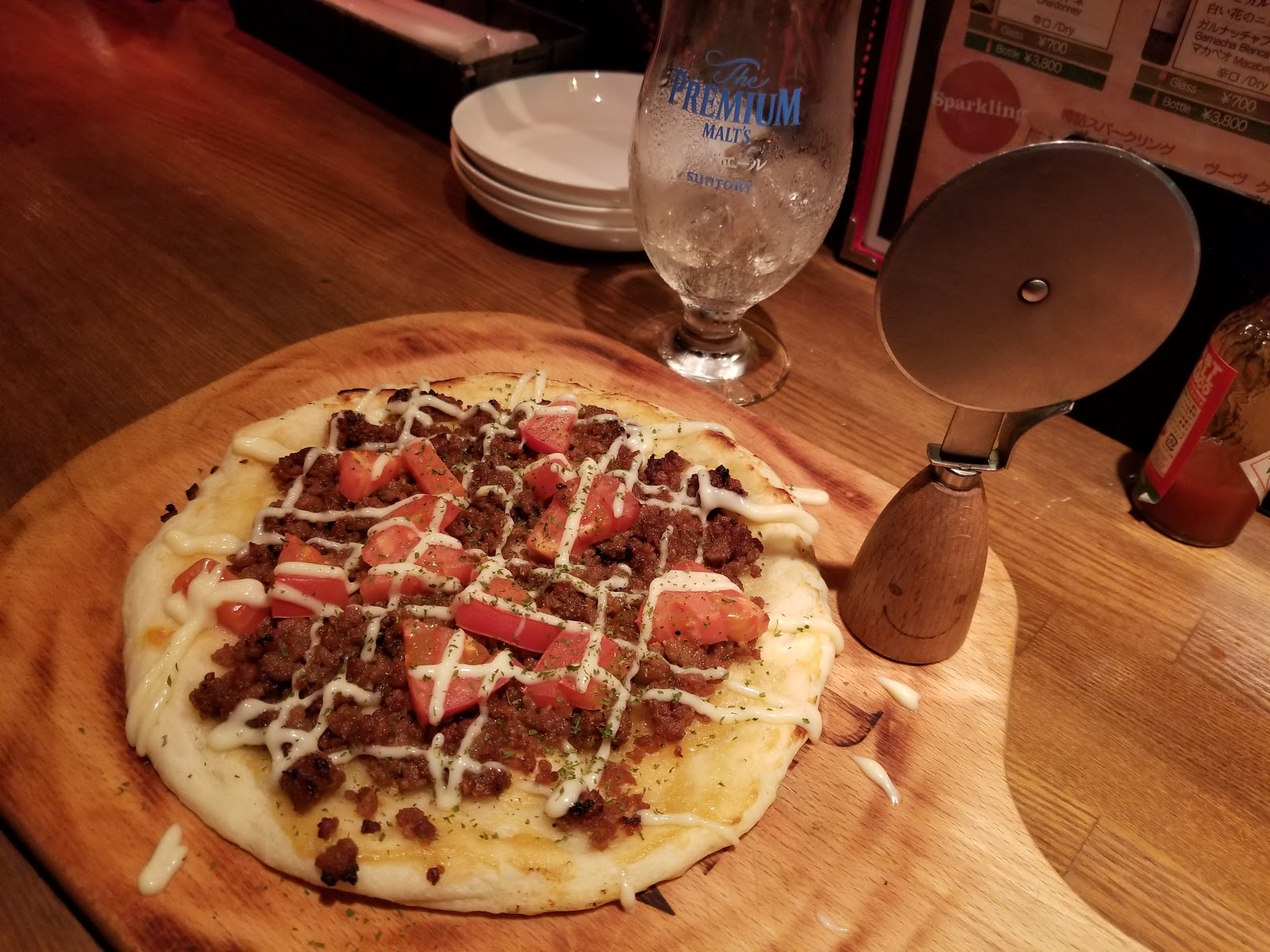
Beef Teriyaki Pizza
Seafood Pizza

Picking Up Pastries on the Way Back to the Hotel

Le Palais Gourmand


Across the street from our hotel is a little pastry shop.  We are picking up some sweets for breakfast and treats.


The Higashiyama Ward Temple and Pagoda

Kyoto, Japan

We took a cab to the next site.  Through the narrow streets to the top of the hill.

Yasaka-no-to, most pagodas are associated with temples and other buildings. This was the Hokanji Temple. The associated buildings, in this case, have all been destroyed by fire, war, and earthquakes.

One of the most scenic views in Kyoto.

The Hokanji Temple (法観寺) was built in 592, which is the oldest pagoda in Kyoto.


In this area, there is the small Kongoji Temple.  The temple was founded in Enryaku 8 years (789)


Thanks to Amy for the images of the Kongoji Temple